


Ballad of a Small Player & Learning from Las Vegas in Macao
- 12 nov 2025
- 6 minuten om te lezen

From Mozambique to Macao
When I was living in Mozambique — a former Portuguese colony — I made a firm decision to one day visit all of Portugal’s former colonies. In the end, I only made it to three African countries: Mozambique, Guinea-Bissau, and Angola.
The other Portuguese territories — Cape Verde, São Tomé and Príncipe (in Africa), and Goa (in India) and Macao (in China) — remained on my wish list. And it was precisely the last of these that recently crossed my path again, unexpectedly, through the Netflix film Ballad of a Small Player (2025) by Edward Berger, starring Colin Farrell as a British gambler who, in the nocturnal world of Macao — the Las Vegas of the East — sinks ever deeper into debt, superstition, and moral decay.
Macao is a peninsula located across from Hong Kong and, after independence, became a special administrative region of China.
The film, based on Lawrence Osborne’s novel, paints a dreamlike world of seduction and decay, where the boundary between reality and illusion blurs. The former Boa/Bela Vista Hotel, founded at the end of the 19th century – and since 1999 the official residence of the Portuguese consul in Macau and Hong Kong – serves as one of the film’s most iconic locations.
Ballad of a Small Player enchants with a burst of carnival colors that leap from the screen. Berger captures the light and hues of temples, beaches, and decadent hotels in an overwhelming visual palette.
In an interview, director Edward Berger explains his choice of Macau:
“Macau has a wealth of locations, from Portuguese colonial mansions to modern high-rises. It possesses glamour, distinctive architecture, brilliance, and pulsing lights at night – visually it’s extraordinarily appealing, and yet almost completely overlooked by the rest of the world.”
Learning from Las Vegas

Watching the film took me back to an architecture book that once shaped my way of thinking: Learning from Las Vegas (1972) by Robert Venturi, Denise Scott Brown, and Steven Izenour. That book taught me that architecture is not only about form and function, but also about symbolism and meaning. Las Vegas – with its neon lights and thematic façades – was presented as a city that can be read like a stage set: ironic, yet full of communicative power.

Macau, too, can be read as a layered city, though one with a very different history. Where Las Vegas evolved along a car-oriented strip of hotels and casinos, Macau developed over four centuries of Portuguese colonial history into a compact, Mediterranean-style city of narrow streets, plazas, and churches – a pedestrian city infused with Chinese influences.


The Cotai Strip in Macau
After the handover to China in 1999, that image changed dramatically.Through land reclamation, a new world arose on Cotai — one of immense hotels, wide boulevards, and themed casinos: a Chinese version of the Strip, where heritage and hypermodern temples of consumption collide.
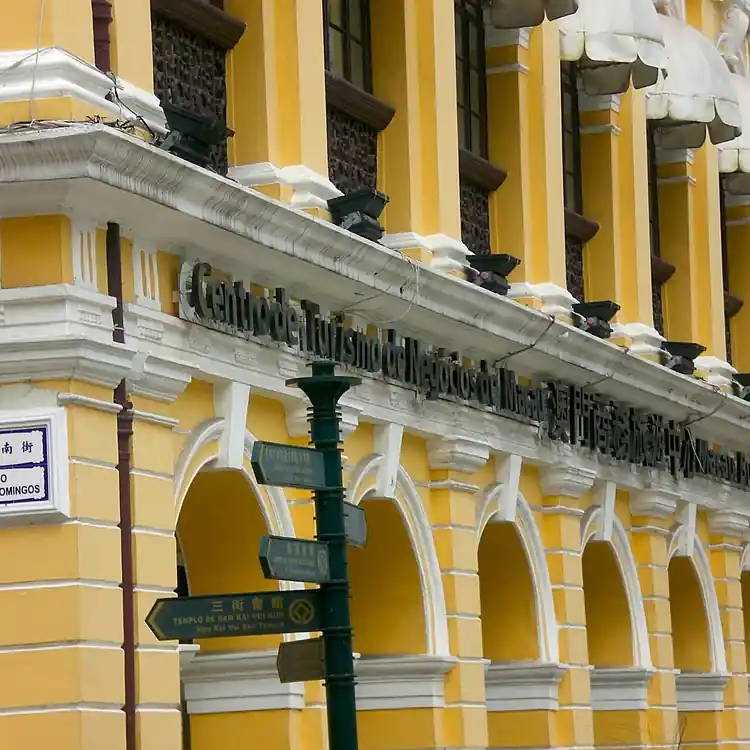



Monumental Buildings in Macau’s Historic Center
Today, Macau boasts 22 UNESCO-listed monuments – ranging from a colonial lighthouse and cathedral ruins to neoclassical buildings in soft pastel tones – alongside a skyline of glittering mega-casinos and futuristic hotels. But there is yet another layer: the often overlooked modernist architecture from the 1950s and 1960s, and even a bit later.
Macau Modern Architecture

The Macau Modern Architecture Walking Guide by Docomomo Macau maps this period comprehensively for the first time.It advocates for the preservation of these modernist buildings – from Art Deco to Brutalism – as part of the city’s collective memory.
For example, architect Rui Leão has long fought to preserve the former Escola Comercial Pedro Nolasco, now the Macau Portuguese School.This robust concrete building, featuring Portuguese tiles and Chinese courtyards, symbolizes the unique cross-pollination of cultures.
The Portuguese School of Macau


The Portuguese School of Macau
It was originally built as the Escola Comercial Pedro Nolasco da Silva, designed by the renowned Portuguese architect Raúl Chorão Ramalho (1914–2001), and constructed between 1963 and 1966.Experts consider the building, now known as the Portuguese School of Macau, one of Chorão Ramalho’s finest works.It is particularly famous for its modernist, brutalist style.
Cinema Alegria


Cinema Alegria – 1952
Cinema Alegria was built in 1952 at the initiative of prominent merchants Ho Yin, Ma Man Kei, and Chan Chek San.It opened in February 1952 with the documentary “A China Libertada” and originally seated 800 people.The building, a well-known example of Art Deco architecture in Macau, was expanded in 1957 and renovated in 1995.Built between 1950 and 1952, it is one of the few old theaters still in use in Macau, featuring an interesting Art Deco façade.
The Red Market of Macau


The Red Market of Macau
After a two-year renovation, the historic Red Market of Macau reopened in May 2024.The iconic 1936 building, with its striking fire-red Art Deco architecture by architect Júlio Alberto Fernandes Basto, has been both refreshed and technically modernized — without losing much of its character.The Red Market stands as a testament to Macau’s ability to preserve cultural heritage while evolving with the times.
The Rainha D. Leonor Building


The Rainha D. Leonor Building – 1961
When the Rainha D. Leonor Building was constructed in the 1950s, it was one of the tallest residential buildings in Macau and the first to be equipped with an elevator.It was designed by José Lei, a Macau-born architect based in Hong Kong and former Olympic marksman.The design shows clear influences from Le Corbusier’s famous Brutalist residential complexes in France.
The Fai Chi Kei Complex

Fai Chi Kei Complex by Architect Manuel Vicente – 1983
In 1983, the magazine L’Architecture d’Aujourd’hui published a special issue titled “Huit Architectures Différentes”. Among the works of Böhm, Renaudie, Niemeyer, Venturi, Shinohara, Sawade, and Foster, the Fai Chi Kei project by Manuel Vicente (1934–2013) was featured — a social housing complex in Macau.
The Fai Chi Kei complex, designed and built between 1979 and 1983, won the ARCASIA Prize in 1994 but was unfortunately demolished in 2010.The building was considered the pinnacle of Vicente’s social housing projects — a synthesis of his complex career and a compromise between old Macau and the urban growth of the
1970s and 1980s.


Interior of the Fai Chi Kei Complex
It was between 1968 and 1969 that Manuel Vicente (1934–2013) collaborated with the renowned American architect Louis Kahn, while the architect couple Robert Venturi and Denise Scott Brown began their study project for the book Learning from Las Vegas.
When Manuel Vicente returned to Macau in 1976, he began exploring this American sense of realism, asking questions about the everyday and the popular. He created the project Macau Glória — a compilation of graphic stories about the city, subtitled A glória do vulgar – The Glory of the Vulgar.It was a kind of Learning from Las Vegas, translated into the context of Macau.
Reflections from My Terrace
When I let my partner read this piece, she mentioned that at the beginning of our relationship — some twenty-three years ago — she had once suggested going to Macau. I had honestly completely forgotten, or perhaps I had suppressed the memory, that’s also possible.
Some time later, she suggested visiting the Cape Verde Islands, but that didn’t fit my schedule, and I wasn’t very interested. Even today, she often asks when we will finally go to Mozambique — the country where I lived and worked for years before I met her.
I keep postponing it, I suspect, out of fear. Fear that nothing remains of my world in the 1980s: the jazz club, the busy terraces, the old theaters and cinemas full of faded glory. Friends who might no longer be there, or who would not recognize me.
Macau, on the other hand, is a blank page. A place without memories, without a past, where everything would be new. I cannot deny that the prospect is alluring. I am going to check where flights are available and what it would cost.
All these are reflections from the terrace of my new apartment in Olhão (Algarve), with a distant view of the ferry to Culatra Island, just off the coast nearby.


Opmerkingen